Why Should We Check Clothing Labels Before Buying?
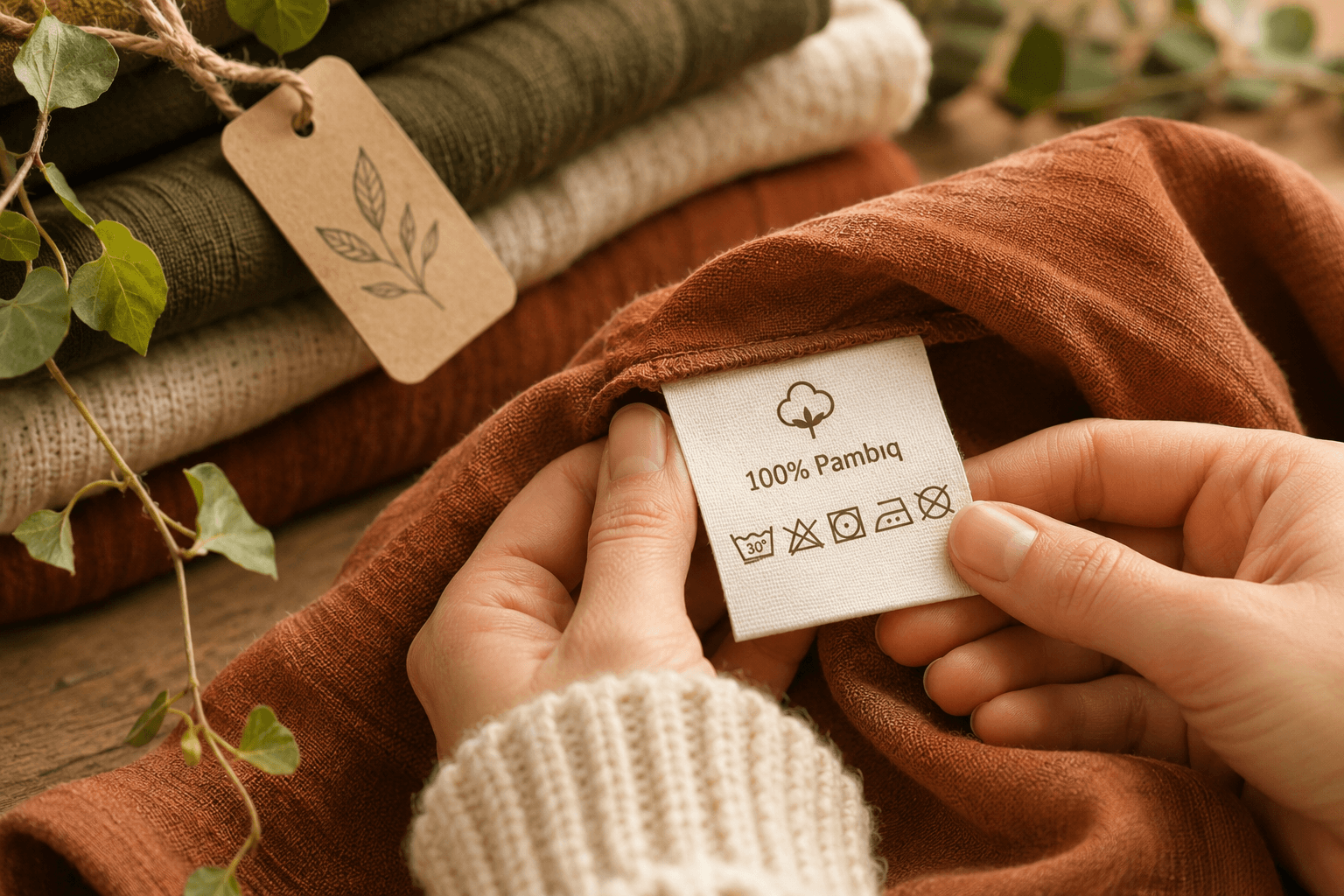
When we find a piece of clothing we like, we usually notice its color, shape, price, and how it looks on us first.
The label, however, often remains a small detail that we only check to find the size—or sometimes cut off and throw away after buying the garment.
Yet those few centimeters of fabric can tell us things about a garment that we cannot learn from its appearance alone:
What is it made of? How should it be washed? Can it go in the tumble dryer? Can it be ironed? Does it require professional cleaning? Where was it made? Does it carry any certifications?
In some countries, certain information must legally appear on clothing labels. For example, under the rules of the U.S. Federal Trade Commission (FTC), most textile products must identify their fiber content, country of origin, and the manufacturer or responsible company. Separate regulations also require care instructions for clothing.
So, the next time you pick up a garment in a store, don't just look in the mirror.
Check the label, too.
1. Start with the Fabric Composition
One of the most common pieces of information on a clothing label is its fiber composition.
For example:
100% cotton
or
70% cotton, 30% polyester
or
55% linen, 45% viscose
These percentages tell us which fibers the garment contains and their proportions.
This matters because two fabrics that look almost identical in a store may actually be made from completely different fibers.
Cotton, linen, wool, polyester, polyamide, viscose, lyocell, and elastane do not have the same properties.
They may differ in:
- How they respond to moisture
- Stretch and elasticity
- Wrinkling
- How warm they feel
- Care requirements
- Durability
But there is an important misconception worth addressing:
“100% natural” does not automatically mean “better quality.”
A label that says 100% cotton tells us nothing about the quality of the cotton, how the fabric was woven, which finishing processes were used, or how well the garment was constructed.
Likewise, the presence of synthetic fibers does not automatically make a garment low quality.
There may be functional reasons for blending different fibers, such as adding stretch, helping a garment maintain its shape, or achieving particular performance characteristics.
That is why we should read fiber composition labels not to make an instant judgment, but to understand what we are buying.
2. What Does “100% Cotton” Tell Us—and What Doesn't It Tell Us?
This phrase deserves a closer look.
100% cotton tells us one specific thing:
The garment's textile fibers are made entirely of cotton.
But it does not tell us:
- How good the cotton quality is
- How durable the fabric is
- How many years the garment will last
- How well the seams are constructed
- How the fabric will behave after its first wash
- Whether the product was manufactured ethically or sustainably
In other words:
The composition label tells part of a garment's story, not the whole story.
To evaluate a garment, we should also feel the fabric, examine the stitching, turn it inside out, and read its care instructions.
3. The Care Label Is Actually an Instruction Manual
The small tubs, triangles, squares, and irons printed on clothing labels are not decorative symbols.
International textile care labeling generally uses five categories:
Washing → Bleaching → Drying → Ironing → Professional textile care
This system is associated with the ISO 3758 standard, whose updated version is ISO 3758:2023.
Here is something particularly useful to know:
Care symbols generally indicate the maximum treatment a garment can withstand.
For example, if a washing symbol shows 30°C, it usually means that the temperature should not exceed 30°C—not necessarily that the garment must always be washed at exactly that temperature.
Gentler care and lower temperatures are generally possible.
4. How Do We Read Washing Symbols?
The wash tub symbol represents washing.
Inside it, you may see numbers such as:
30, 40, or 60
These indicate the maximum washing temperature in degrees Celsius.
For example:
30°C → Wash at a maximum temperature of 30°C.
If there is one line underneath the tub, a gentler washing cycle is required.
Two lines indicate an even more delicate process.
A hand symbol indicates hand washing.
If a symbol has a large X through it, that particular care method must not be used.
5. The Triangle — Bleaching
The triangle symbol refers to bleaching.
An empty triangle indicates that suitable bleaching agents may be used.
A triangle containing two diagonal lines means that only oxygen-based or non-chlorine bleach is permitted.
A crossed-out triangle means:
Do not bleach.
This is especially important when we instinctively reach for bleach to remove a stubborn stain.
6. The Square — Drying
A square provides information about drying.
If there is a circle inside the square, it refers to tumble drying.
The number of dots indicates the permitted heat level.
Other square symbols may represent different methods of natural drying.
If a garment's label prohibits tumble drying, washing it at the correct temperature may still not be enough. Incorrect drying can damage the product.
7. The Dots on an Iron Symbol Are Not Random
The iron symbol tells us what level of heat the garment can tolerate.
As the number of dots increases, so does the permitted temperature.
According to GINETEX information, the maximum soleplate temperatures for different ironing symbols are 120°C, 160°C, and 210°C.
There is an especially useful rule here:
Rather than choosing the ironing temperature based only on fiber composition, it is better to follow the care label of the specific garment.
A garment is not made of its main fabric alone.
It may also include prints, bonded details, embroidery, special surface finishes, buttons, or other components.
The manufacturer determines the care instructions by considering the garment as a whole.
8. What Does the Circle Mean?
A circle on a care label refers to professional textile cleaning.
Letters inside the circle tell professional cleaners which processes and solvents may be used.
This means that some of these symbols are actually technical instructions intended more for professional cleaning servicesthan for consumers.
Warnings such as “Dry Clean Only” should not be ignored.
For example, under FTC regulations in the United States, a “Dryclean Only” instruction should be supported by a reasonable basis for believing that washing would harm the product.
9. Why Can Two Garments With the Same Composition Have Different Care Labels?
This is an interesting question.
Imagine two shirts, both labeled:
100% cotton
But one recommends washing at 40°C, while the other recommends 30°C.
That does not necessarily mean one of the labels is incorrect.
Care instructions are not determined by fiber type alone.
GINETEX explains that care information also takes into account a product's color, finishing, and components such as buttons, zippers, and appliqués.
So instead of asking:
“At what temperature should cotton be washed?”
A better question is:
“How should this particular cotton garment be washed?”
The best place to look for the answer is its care label.
10. The Label May Also Tell Us Where the Garment Was Made
In many markets, identifying the country of origin is part of legal labeling requirements.
For example:
Made in Portugal
Made in Türkiye
Made in China
Made in Italy
And so on.
But we should be careful about how we interpret this information.
“Made in...” is not a quality rating.
The country name tells us about the product's manufacturing origin, but it does not prove that the garment was made well or poorly.
The same country may produce both exceptionally high-quality garments and inexpensive mass-market clothing.
Rather than assuming that “Made in X” automatically means high quality, we should treat it as additional information about the product.
11. What About Certifications?
Sometimes, in addition to fiber composition and care information, clothing labels display certification marks.
One example is OEKO-TEX® STANDARD 100.
This certification indicates that the components of a textile product have been tested for certain harmful substances and meet the limits established by the standard.
However, it is important not to exaggerate what a certification means.
For example:
OEKO-TEX STANDARD 100 does not mean that a product was manufactured in an entirely environmentally friendly or sustainable way.
We need to understand exactly what each certification evaluates.
The same principle applies to other labels:
See the logo → Read its name → Check what it actually certifies.
A green-colored symbol alone does not automatically make a product sustainable.
12. A Label Is Not a Guarantee of Quality
This may be one of the most important points in the entire article.
A care label tells us how to look after a garment.
A composition label tells us which fibers were used.
An origin label tells us where it was manufactured.
A certification may indicate compliance with a particular standard.
But none of these things, on its own, means:
“This is a high-quality garment.”
GINETEX also explicitly states that care labeling does not guarantee product quality.
To evaluate quality, we need to read the label alongside the garment itself.
13. After Reading the Label, Examine the Garment
You've read the label.
Now turn the garment inside out.
Take a closer look:
- Are the seams straight?
- Are any threads coming loose?
- How are the seam allowances finished?
- What does the fabric look like when held up to the light?
- Are the buttons securely attached?
- Does the zipper work smoothly?
- If the fabric is patterned, how well do the patterns align at the seams?
- How does the fabric feel in your hands?
When you combine these observations with the information on the label, you get a much more complete picture of the garment.
14. A 30-Second Label Check Before Buying Clothes
You don't need to do extensive research every time you shop.
You can develop this simple habit:
1. Composition
What is it made of?
2. Care
Am I willing to care for this garment the way it requires?
3. Origin
Where was it manufactured?
4. Certifications, if any
What exactly do they verify?
5. Examine the garment itself
What about the fabric, seams, buttons, zipper, and interior finishing?
Sometimes, all of this takes less than 30 seconds.
Do I Really Want a Shirt That Says “Dry Clean Only”?
Reading the label offers another advantage:
We can understand not only what a product is, but also what living with it will be like.
You may find a beautiful garment.
But if it:
- Requires special care after every wear
- Cannot be tumble-dried
- Must be washed at very low temperatures
- Frequently requires professional cleaning
Then it is worth considering whether it fits your everyday life before buying it.
From this perspective, a care label does not only answer:
“How should I wash this?”
It also helps answer:
“Does this garment suit my lifestyle?”
Before Cutting Off the Label
Sometimes we want to remove a label because it irritates our skin.
You can cut it off, but first, it is useful to photograph:
- The fiber composition
- The care symbols
- The product or model information
Six months later, you may not remember the correct washing temperature for that garment.
You could even create a small album on your phone called “Clothing Labels.”
Next Time You Buy Clothes...
Pick up the garment.
Feel the fabric.
Turn it inside out.
Examine the stitching.
Then find the label.
Because a label cannot tell us in one sentence whether a garment is good or bad.
But it gives us enough clues to ask the right questions.
What is it made of?
How should I care for it?
Is that level of care realistic for me?
What do the claims made about it actually mean?
And once we've learned all of that, one important question remains:
Will I actually wear this garment?
Perhaps more thoughtful shopping begins with something as small as a clothing label.
Madu — Little stories that begin with fabric.